In-Store vs. Online Media: How to Allocate When You Have Both
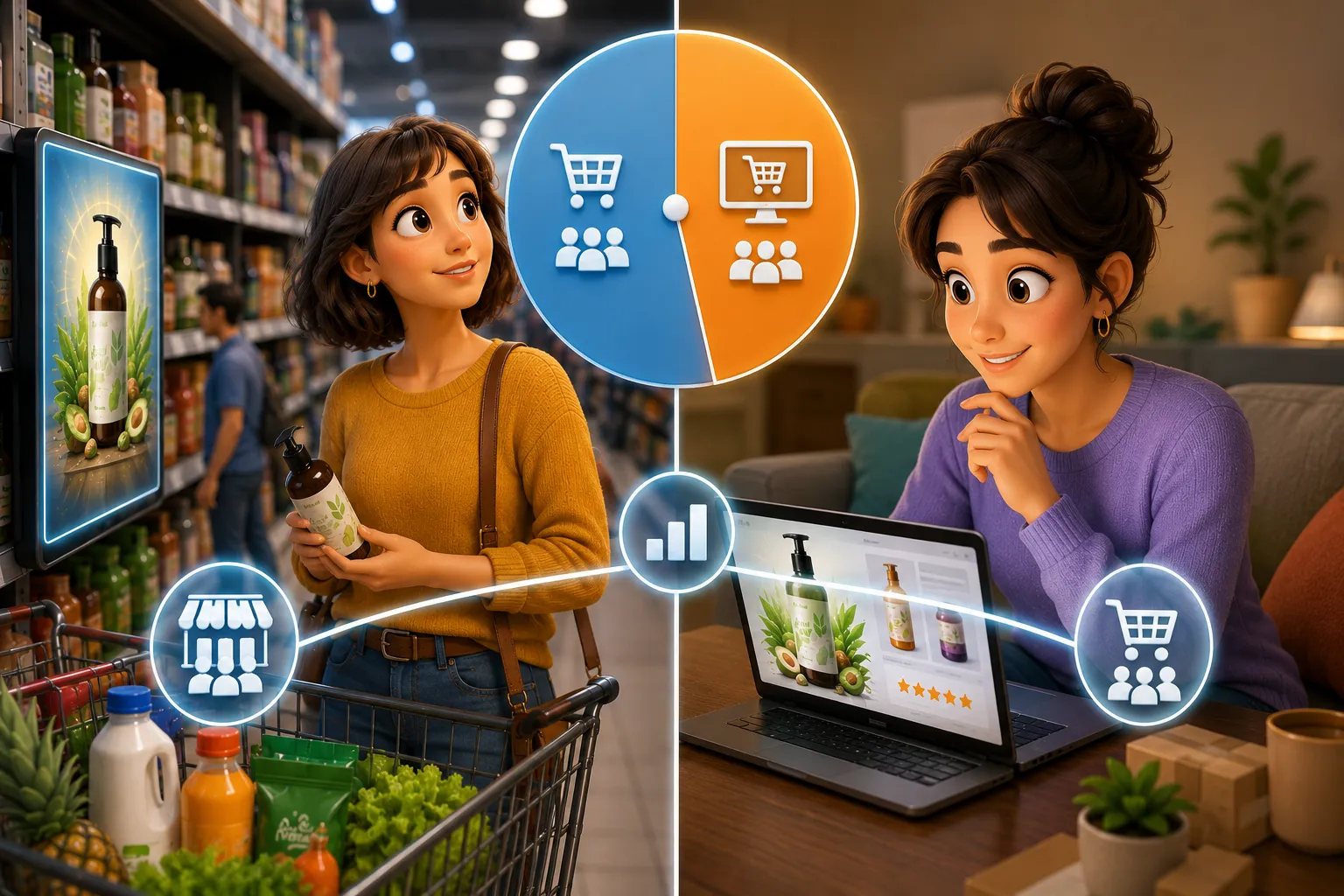
In-Store vs. Online Retail Media: How to Allocate When You Have Both
Almost every brand running retail media at a major grocery chain is simultaneously running in-store and online activations. The question that almost none of them have answered with data is: what is the right allocation between the two?
The answer in most planning decks is whatever split the account team agreed to in the last JBP, adjusted slightly for wherever last quarter's performance was weakest. That is not an allocation strategy. It is allocation by inertia.
An evidence-based allocation between in-store and online retail media starts with a clear understanding of what each channel is best suited to do in your specific category, for your specific shopper segment, at the specific retailer in question.
"Brands that allocate in-store and online retail media based on category purchase occasion data consistently outperform brands using static allocation ratios on both incremental lift and gross-to-net." -- Skai
What each channel is actually good at
Online retail media - sponsored products, display, and video on the retailer dot-com and app - is best at: reaching shoppers who are browsing the category with purchase intent but have not yet decided, building product consideration for new or infrequent buyers, and driving add-to-cart for planned purchases that begin online even if they complete in-store.
In-store retail media is best at: intercepting the impulse decision that was not pre-planned, reinforcing category consideration at the moment of physical shelf evaluation, and reaching shoppers who do not engage significantly with the retailer app between trips. For habitual categories where most purchase decisions are made at the shelf rather than pre-planned, in-store has a structural consideration advantage.
The key diagnostic: what percentage of your category purchases are pre-planned versus impulse? For categories where shoppers typically add the product to a list before the trip - household essentials, specialty health products, planned indulgences - online retail media reaches buyers at the decision point. For categories where the purchase happens at the shelf - grab-and-go beverages, snack purchases, seasonal displays - in-store media is at the decision point.
The four factors in an evidence-based allocation
- Purchase occasion data: what percentage of your category buyers report planning the purchase before the trip versus deciding at the shelf? Your data provider or retailer data partner can surface this for your specific category.
- Online versus in-store volume split: what percentage of your category volume moves through the retailer dot-com versus the physical store? As online grocery penetration grows, a higher proportion of category decisions are happening in the online environment.
- Competitive investment: where are your competitors concentrating their retail media investment? If the category is heavily competed online and you have strong in-store distribution, in-store may offer less competitive resistance. If competitors are dominating in-store display, online may be the higher-opportunity channel.
- Measurement confidence: where can you generate the most credible incrementality measurement? Allocating more investment to the channel where you can prove lift is not just good measurement practice - it is how you build the evidence base for future allocation decisions.
-> In-Store Full-Funnel -- agencyfiveeighty.com/in-store-media-full-funnel
-> Commerce Media Budget Allocation -- agencyfiveeighty.com/commerce-media-budget-allocation-2026
The coordination opportunity between both channels
The most interesting allocation question is not which channel gets more budget - it is how the two channels can reinforce each other to generate lift that neither produces alone.
The coordination pattern that works: online retail media builds product consideration among pre-trip shoppers, surfaces the offer or promotion that is also available in-store, and increases the probability that the shopper visits the aisle with your product already on their mental list. In-store media then reinforces the message at the shelf, closes the consideration gap for shoppers who are seeing your product for the first time, and drives the trial purchase.
Measuring this interaction requires tracking shoppers who were exposed to both online and in-store media in the same campaign period against shoppers exposed to only one channel. The conversion rate difference between single-channel exposed and dual-channel exposed shoppers is the coordination premium. For most brands that have measured this, the premium is real and justifies the operational complexity of running coordinated activations across both environments.
Five Eighty plans in-store and online retail media as a coordinated system - because the allocation question and the coordination question are the same question asked from different angles.